

First Graduate Supervisor Training and Industry Supervisor Appointment Ceremony Held at Our University
| Updated:16 April, 2026 |
On the afternoon of April 15, our university held its first graduate supervisor
training and industry supervisor appointment ceremony. Vice President Wei Xiaohui
attended the ceremony and delivered a speech. Professor Liu Qingsong from Southern University of Science and Technology (SUSTech) was invited to provide specialized
training. On-campus graduate supervisors and newly appointed off-campus industry
supervisors participated in the event. The ceremony was hosted by Feng Kejun,
Director of the Department of Science and Technology (Graduate Affairs Department).
In her address, Vice President Wei Xiaohui noted that the university had successfully
obtained master's degree authorization in 2024 and enrolled its first cohort of 85
master's students in 2025, covering three professional degree programs: Education,
Materials and Chemical Engineering, and Electronic Information. The university is
implementing a full on-campus supervisor + industry supervisor dual-supervisor
system. She emphasized that supervisors are the primary persons responsible for
postgraduate cultivation, and their academic competence, sense of responsibility,
and dedication to mentoring directly affect the quality of talent cultivation and the
university's academic reputation. She put forward three expectations for all
supervisors: first, to remain committed to the fundamental task of fostering virtue
through education, integrate ideological and political education throughout the
entire cultivation process, and embody the spirit of educators; second, to adhere
to academic integrity, uphold the spirit of science, and rigorously oversee key stages
such as topic selection, proposal defense, practical training, and thesis writing;
and third, to strengthen collaborative education, deepen industry-university-research
cooperation, build platforms for practical innovation, and cultivate high-level applied
talents suited to regional development.
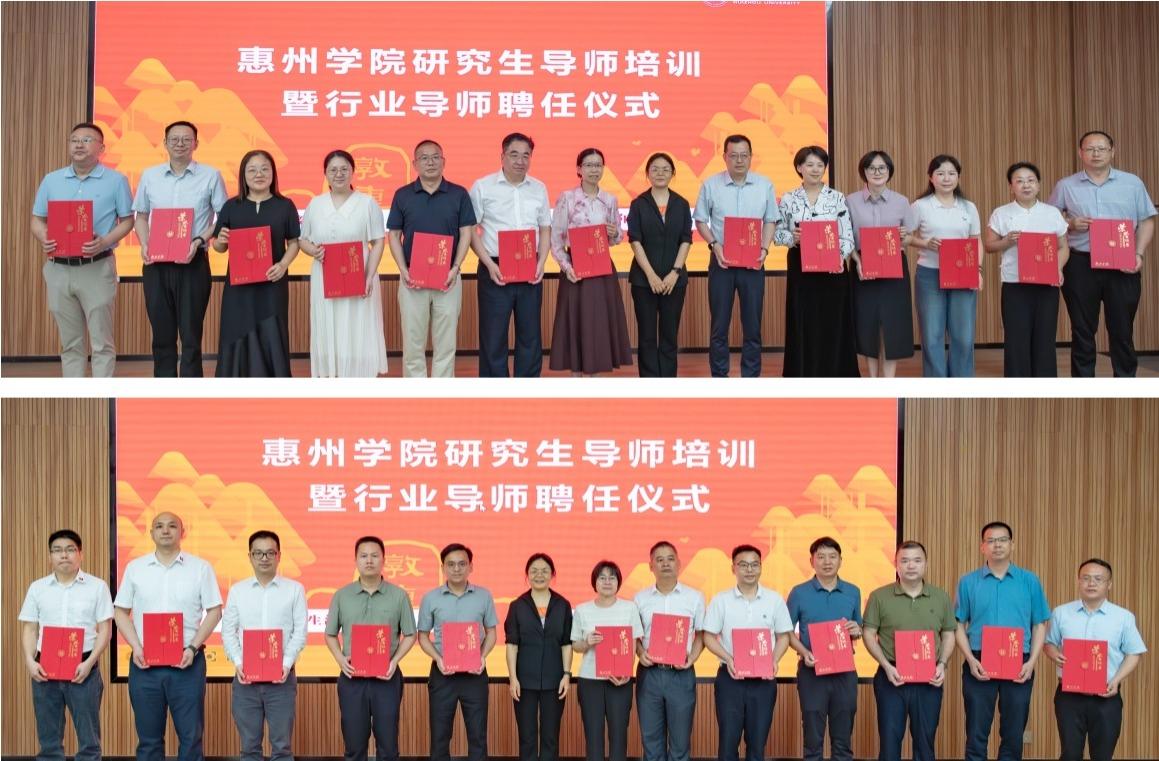
During the appointment session, Vice President Wei Xiaohui presented appointment
letters to over 20 industry supervisors from Huizhou’s educational research institutes,
primary and secondary schools, and renowned enterprises. These industry
supervisors, possessing both front line practical experience and professional expertise,
are expected to serve as important bridges connecting campus and industry, injecting
strong momentum into the development of graduate students’ practical skills.
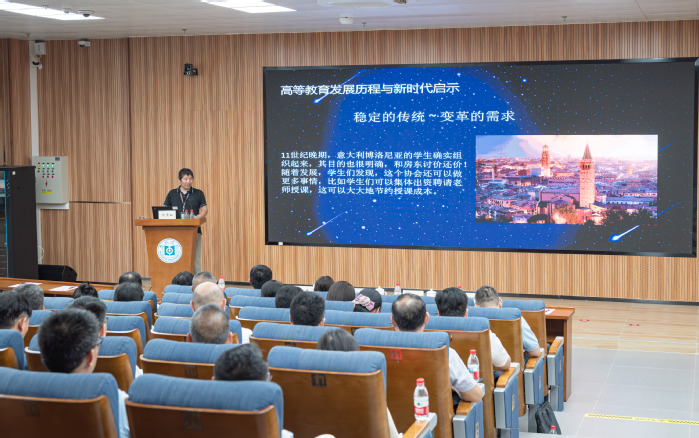
In the specialized training session, Professor Liu Qingsong delivered a lecture titled
How to Be a Supervisor. Drawing on decades of experience in graduate student
mentoring, he systematically elaborated on the role of a supervisor, the functions
of universities, and the historical development of higher education. He provided
an in-depth interpretation of core themes such as innovative thinking, teaching
and learning mutually benefiting each other, academic integrity, and mentoring
methods. He advocated the educational philosophy of leaving no one behind,
emphasizing respect for individual differences among students, strengthened
psychological guidance, and adherence to immediate feedback and outcome
orientation. He also shared practical mentoring methods such as the one-hour
feedback principle, task decomposition method, and laboratory culture building.
The training was rich in theory and vivid in examples, offering both intellectual
depth and practical guidance, providing a clear road map for all supervisors to
fulfill their duties.
In his concluding remarks, Feng Kejun stated that Professor Liu Qingsong’s report was
rich in content and profound in thought, combining a broad perspective on higher
education theory with practical depth in graduate training, thereby offering valuable
experience for the construction of our university’s supervisor team. He expressed
the hope that all supervisors would take this training as an opportunity to enhance
exchanges, learn from each other, earnestly fulfill their supervisory responsibilities,
and contribute to advancing graduate education at our university to a new level.