

Vice President Zheng Wen Led Delegation to Visit
Universities in the U.S.
| Updated:06 October, 2025 |
To further consolidate the foundation of exchanges and cooperation between our
university and relevant U.S. institutions, expand channels for international education,
and enhance the quality and efficiency of international cooperation programs, a
delegation led by Vice President Zheng Wen visited the United States from September
22 to 27. The delegation paid successive visits to the University of North Alabama (UNA)
and the University of Alabama at Birmingham (UAB), engaging in in‑depth discussions
on core topics including joint education, talent training, faculty visiting programs,
academic exchanges, and industry‑university integration, so as to build a broader
platform for future cooperation between the institutions.
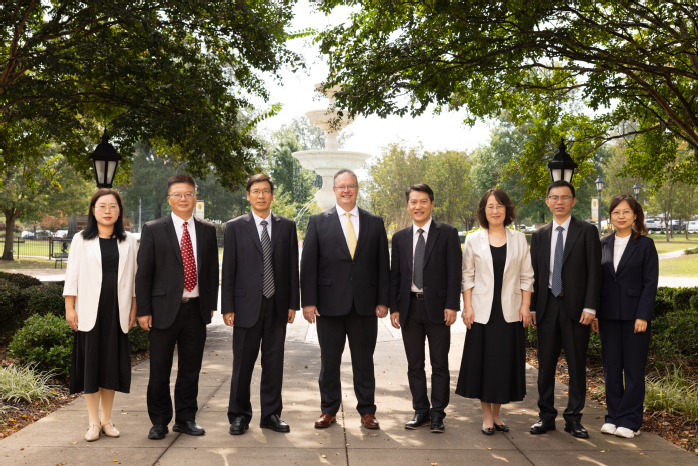
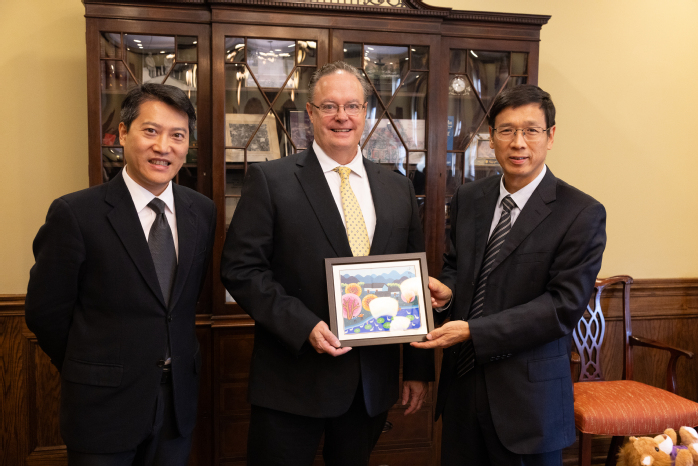
At the University of North Alabama, the delegation was warmly received by President
Ken Kitts, Provost and Executive Vice President Brien Smith, Vice President Hu Po,
and other university leaders. During the meeting, Brien Smith extended a warm
welcome to the delegation, noting that UNA highly values its partnership with our
university. He expressed the expectation that both sides would build on existing
cooperation to deepen collaboration in platform co‑construction, joint talent
development, disciplinary advancement, and faculty exchange, systematically plan
cooperation priorities, and jointly elevate the international education standards of both
universities. Zheng Wen reviewed the history of cooperation between the two
institutions, stating that based on a long‑standing and stable partnership, significant
achievements have been made in international talent development, mutual learning of
educational philosophies, and innovation in teaching methods. He emphasized the
hope that both sides would further consolidate cooperation foundations, seek new
breakthroughs in joint disciplinary development, faculty training platform construction,
two‑way student and faculty exchange, and academic and research collaboration, and
advance cooperation toward deeper and higher‑quality development.
Focusing on key joint programs, the delegation held dedicated discussions with Katie
Kinney, Dean of the College of Education and Human Sciences, Matthew Green,
Associate Dean, Doug Barrett, Dean of the Sanders College of Business and Technology,
and Jana Beaver, Associate Dean. The two sides reviewed progress on the China‑Foreign
Joint Education Program in Early Childhood Education and the “3+2” Bachelor‑Master
Articulation Program in Financial Management, conducted in‑depth discussions on
optimizing collaborative teaching, co‑building curriculum resources, and improving
quality assurance systems, and agreed to establish a training mechanism for dual
enhancement of academic ability and comprehensive competence, laying a solid
academic and cultural foundation for students pursuing further studies in the United
States.
Zheng Wen stressed that joint programs serve as the core link in inter‑university
exchanges. Going forward, efforts should focus on the goals of joint discipline
development, resource sharing, and collaborative talent cultivation, broadening the
international horizons of teachers and students through diverse forms such as
collaborative teaching, faculty visiting and research, student exchange, and short‑term
study tours. Meanwhile, high‑quality educational resources should be continuously
integrated, program connotation strengthened, and sustainable development of both
universities’ education promoted through quality improvement of joint programs.
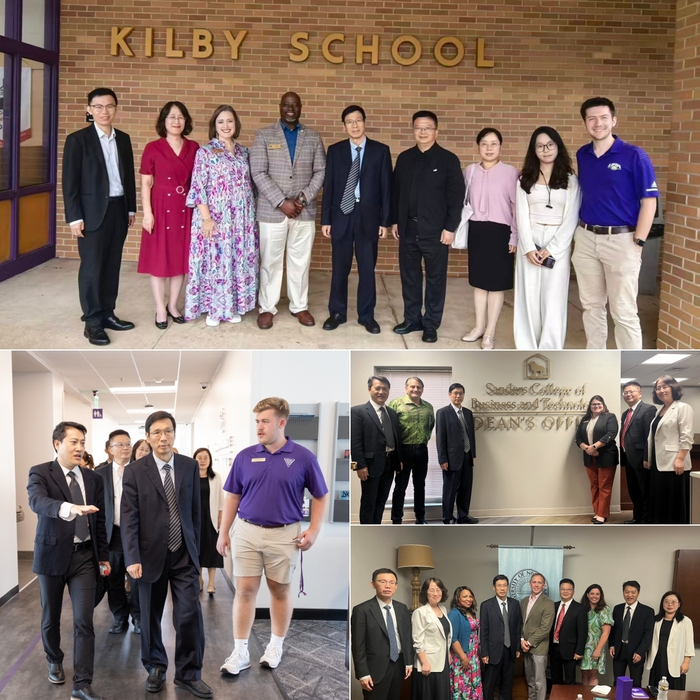
To learn advanced experience in building teacher education practice bases at U.S.
universities, the delegation conducted a special investigation at UNA’s affiliated schools,
focusing on the environmental design, teaching facility configuration, and student
teacher internship mechanisms of the affiliated kindergartens and primary schools.
Through on‑site classroom observations and in‑depth interviews with the school’s
management team, the delegation systematically learned about UNA’s distinctive
models and innovative measures for developing student teachers’ practical abilities,
providing valuable reference for optimizing our university’s practical teaching system
for student teachers.
During the visit, the delegation also met with student representatives from our
university studying at UNA, inquired in detail about their academic progress and
daily life, fully affirmed their proactive adaptation to overseas environments
and active participation in academic exchanges, and encouraged them to cherish
the learning opportunities, enhance their capabilities in diverse dimensions, and
act as people‑to‑people ambassadors for inter‑university exchanges.
At the University of Alabama at Birmingham, the delegation focused on investigating
practices in building industry‑education‑integrated campuses, functional area planning,
and the operation of comprehensive student service centers. It was learned that UAB
integrates student life services, academic exchange support, mental health care, and
administrative services with industry‑education practice, forming a
community‑oriented,comprehensive campus operation model and an educational
ecosystem where “space equals education.” Delegation members noted that this
integrated model provides a practical example for our university to advance student
management reform and enhance the efficiency of student community services.
Going forward, relevant experience can be adapted to optimize campus functional
layout and better support student growth and educational development.
This visit to the United States not only further enhanced mutual understanding
between our university and its U.S. partner institutions, but also deepened
consensus on cooperation and expanded collaboration space. Through a series of
exchanges, both sides clarified key priorities and implementation paths for future
cooperation, injecting new momentum into our university’s pursuit of high‑level
educational opening‑up and the improvement of international education standards
and quality.
Relevant officials and faculty representatives from the Academic Affairs Department
and the School of Educational Science accompanied the visit.