

President Wang Sheng Led Delegation to Visit
Australian Universities
Updated:27 October, 2025 |
To further expand channels for international exchanges and cooperation, deepen
multi‑level and wide‑ranging collaboration with Australian universities in education,
science and technology, and cultural fields, and accelerate the improvement of the
university’s international education standards, President Wang Sheng led a delegation
to visit Western Sydney University, Macquarie University, and Queensland University of
Technology (QUT) in Australia from October 20 to 24. The delegation
conducted in‑depth and pragmatic discussions on key projects including international
joint education, collaborative talent training, faculty visiting programs, and
international scientific research cooperation, striving to build high‑level cooperation
platforms with world‑class international universities.
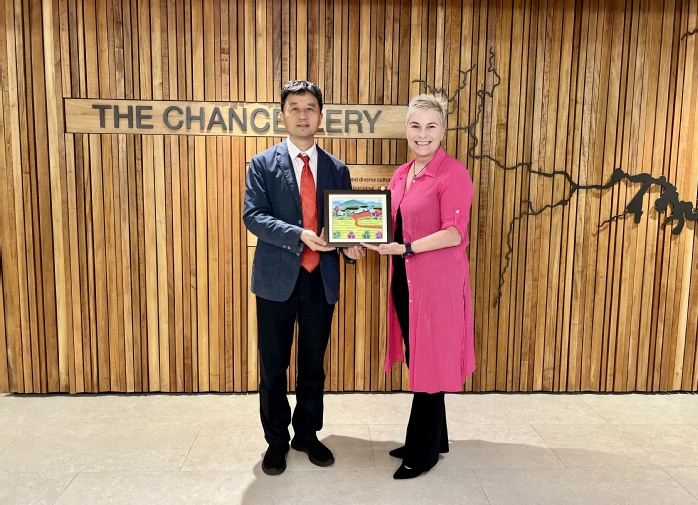
At Western Sydney University, the delegation held discussions with Nicolene Murdoch,
Vice President for International Affairs; Liz Smith, Director of the International Office;
and relevant heads of the School of Education, School of Computer, Data and
Mathematical Sciences, School of Engineering, Design and Built Environment, and
School of Humanities and Communication Arts. Nicolene Murdoch introduced the
university’s founding history, faculty structure, academic programs, and international
education development. She noted that Western Sydney University has developed
rapidly in recent years with growing educational strength and international influence,
and has always attached great importance to various exchanges and cooperation with
Chinese universities. She expressed hope that, building on the existing sound
cooperation foundation, the two universities would continue to deepen communication,
expand cooperation areas, and advance more substantive projects in faculty and
student exchanges, joint program development, and scientific research cooperation, so
as to achieve comprehensive improvement in the quality and level of cooperation and
jointly create a new pattern of mutually beneficial international development.
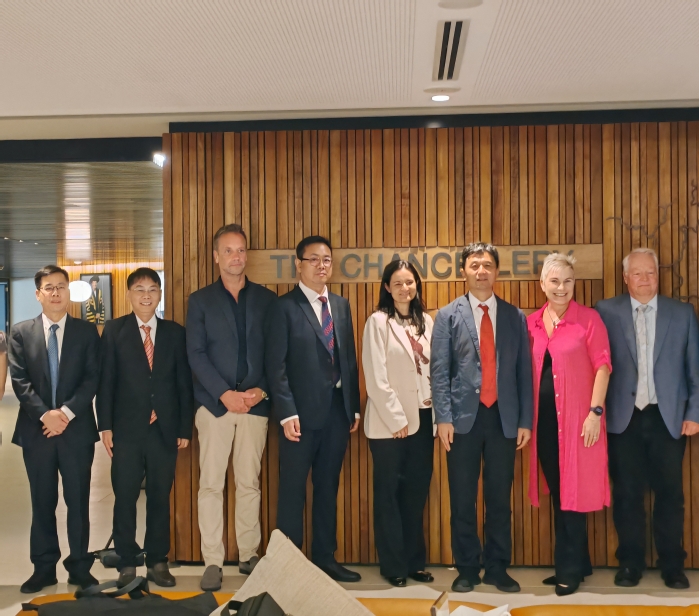
Wang Sheng pointed out that since the formal signing of the cooperation agreement
in 2021, the two universities have made solid progress in joint doctoral training and
academic exchanges starting from the field of education, with increasing interactions
between teaching and research staff and initial achievements in multiple cooperation
projects. He emphasized that the fruitful cooperation results not only consolidate
bilateral relations but also form a positive demonstration effect. Taking this opportunity,
the two universities should extend cooperation to cutting‑edge disciplines and
emerging strategic fields such as electronic information, computer science, artificial
intelligence, data science, materials science, and chemical engineering. Through joint
development of high‑level education programs, two‑way faculty exchanges, joint
application for international research projects, and joint construction of research
platforms, the two sides can promote interdisciplinary integration and collaborative
professional development, and realize the sharing of high‑quality educational resources
and joint talent training. It is expected that the two universities will work together to
continuously enrich cooperation connotations, innovate cooperation mechanisms, and
comprehensively enhance their international influence and educational
competitiveness.
At Macquarie University, the delegation held discussions with Lee‑ann Norris, Vice
President for International Affairs; Michael Sheng, Dean of the School of Computer
Science, Faculty of Science and Engineering; Stella Wang, Greater China Director of
Future Students; and other relevant officials. Lee‑ann Norris briefly introduced
Macquarie University’s development. She stated that Macquarie University is a
fast‑growing and innovative research‑intensive university. With outstanding academic
strength, multiple disciplines rank among the world’s top 100, and its teaching and
research standards have long been among the top Australian universities. The
university adheres to innovation‑driven teaching and research development, attaches
great importance to in‑depth industry‑university integration, and leverages its unique
geographical advantage adjacent to Macquarie Park, known as the “Silicon Valley of the
Southern Hemisphere.” It has established close industry‑university cooperation
relationships with numerous world‑renowned enterprises and high‑tech companies,
effectively promoting the transformation and application of research achievements
while providing students with abundant internship and employment opportunities,
significantly enhancing their practical capabilities and global competitiveness.
Wang Sheng noted that as a regional applied university rooted in the Guangdong‑Hong
Kong‑Macao Greater Bay Area, our university always regards serving regional economic
and social development as its core mission, committed to cultivating high‑quality
applied talents with international vision, innovative spirit, and practical ability. The
key to achieving this goal lies in building an open and collaborative educational
ecosystem, deepening industry‑university integration, and promoting the organic
connection of education, talent, industrial, and innovation chains. He highly praised
Macquarie University’s advanced concepts and successful practices in promoting
in‑depth industry‑university integration, facilitating research transformation, and
enhancing graduate employability, which provide valuable reference for our university
to deepen educational reform and improve the quality of applied talent training. It is
expected that, building on existing international joint training programs, the two
sides will further expand the breadth and depth of cooperation, gradually extending
it to faculty exchanges, joint research team building, collaborative project application,
and joint academic research, so as to jointly build a high‑level international
cooperation platform and inject new momentum into innovative development for
both institutions.
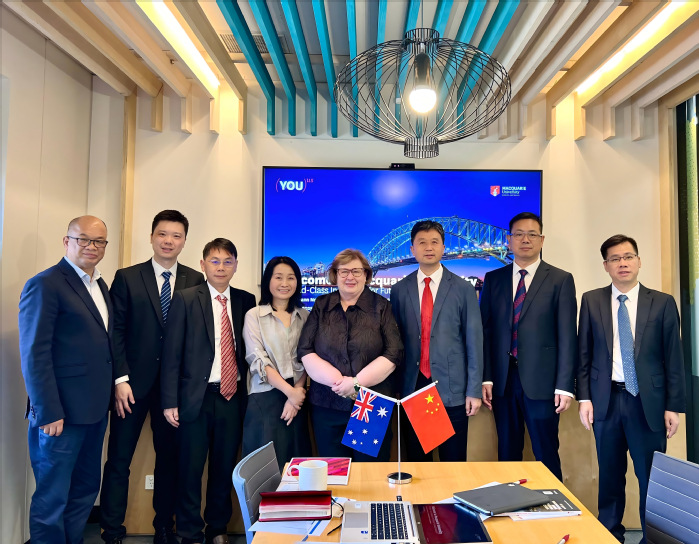
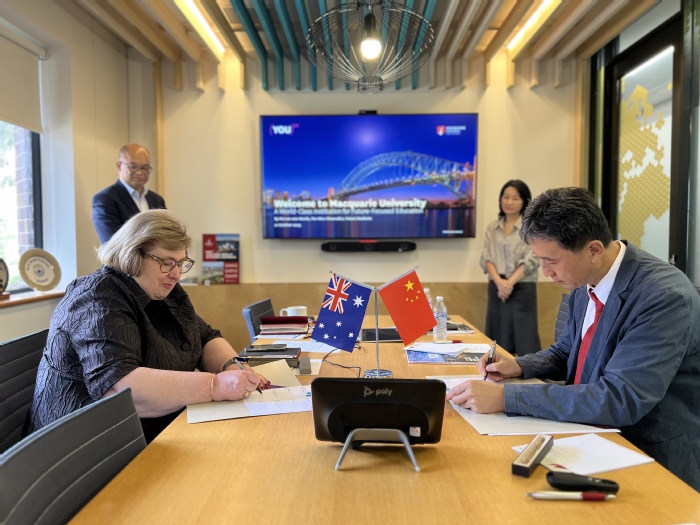
During the visit, the two universities formally signed an MoU, laying a solid
foundation for the implementation of multiple substantive cooperation projects
in the future.
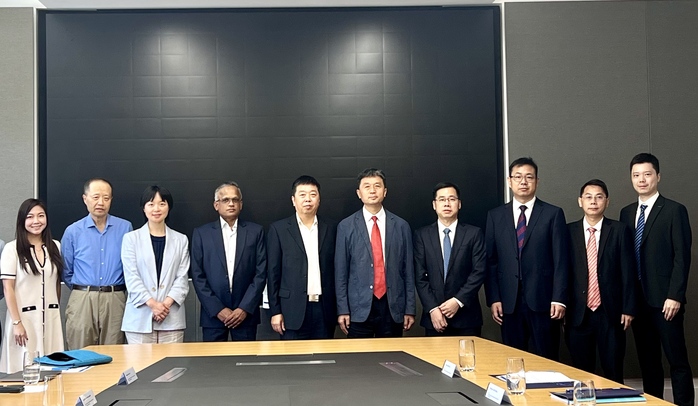
At Queensland University of Technology, entrusted by Mark Harvey, Vice President for
International Cooperation, Yuantong Gu, Vice President for Research Career
Development; Emily Luo, North Asia Director of the International Cooperation Office;
and professors from the School of Electrical Engineering and Robotics, and the School
of Mechanical, Medical and Process Engineering met with the delegation. Yuantong Gu
warmly welcomed the delegation and expressed gratitude for our university’s previous
hospitality. He introduced that QUT boasts strong research strength and an innovative
atmosphere, with multiple internationally renowned research centers. Adhering to the
educational philosophy of “Education for the Real World”, the university closely
integrates academic research with industrial needs and maintains close ties with many
global leading enterprises. Graduates are widely recognized for their solid expertise,
strong practical ability, and quick adaptability. Employment rates and quality of
graduates from its signature disciplines such as electrical engineering and built
environment consistently rank among the top in Australia.
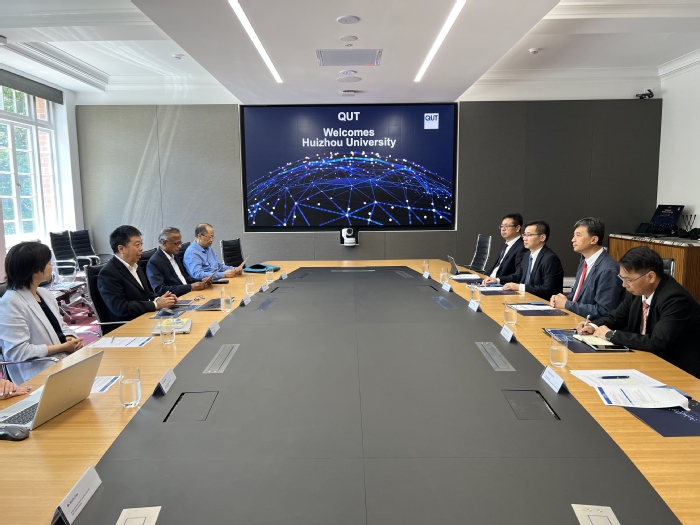
Wang Sheng detailed our university’s geographical advantages, scale, faculty structure,
key disciplines, program layout, talent training characteristics, and international
development. He noted that our university shares similar talent training philosophies
with QUT, closely aligning with regional industrial needs and continuously optimizing the
applied talent training system. Since the formal signing of the framework cooperation
agreement earlier this year, joint training programs in fields such as electronic
information and electrical engineering have been identified as the priority and key
breakthrough areas for cooperation, which have broad prospects for development. He
expressed hope that relevant schools and functional departments of both
universities would further strengthen communication and coordination, reach
consensus on specific matters as soon as possible, and promote the implementation
of joint training programs. It is also expected that the two universities will deepen
collaborative innovation in scientific research, promote academic exchanges and
visits, and leverage QUT’s strong research capabilities and advanced platforms to
carry out pragmatic cooperation in joint application for international research projects,
joint laboratory construction, and key technology research, so as to achieve mutual
benefit and common development.
During the visit, the delegation also met with graduates and alumni pursuing master’s
and doctoral degrees at the University of Sydney, the University of New South Wales,
and other institutions. Wang Sheng inquired in detail about their study and life abroad,
encouraging them to aim high and stay grounded, expand their international horizons
while actively promoting the alma mater’s image, and strive to grow into outstanding
talents with global vision and national sentiment.
The visit to Australia yielded fruitful results. It not only deepened consensus on
cooperation in talent training, faculty exchange, and scientific research with relevant
Australian universities, but also effectively expanded international exchange channels
and platforms. Multiple key cooperation projects made substantial progress during
the visit, marking a new stage of educational cooperation between our university and
Australia, and providing new opportunities and impetus for promoting high‑quality
development of international exchanges and opening a new chapter in international
education.
Relevant officials from the School of Computer Science and Engineering, School of
Electronic Information and Electrical Engineering, School of Mathematics and Statistics,
and the International Exchange and Cooperation Department accompanied the visit.